From a childhood spent surrounded by glitchy gadgets to global recognition as a pioneer of calm technology, Amber Case is setting design standards that reimagine how tech fits into daily life.
As a child, Amber Case BA ’08 fell asleep surrounded by technology. Her father, a broadcast engineer, built ingenious gadgets—a bedtime light, a square-pattern sprinkler, even a dog-bark-activated sound system.
“The things my dad built usually worked beautifully and forever,” she says. The gadgets he didn’t build often ended up in her room, like a voice-activated lamp that switched on whenever trucks rumbled past. “I had to constantly adjust the sensitivity. Those experiences made me hyperaware of how design impacts daily life.”
That awareness now drives her work as a self-described “design disruptor” and entrepreneur. In May 2024, she launched the Calm Tech Institute, a research firm that awards certifications for products that respect time, attention, and humanity—helping technology fit into our lives instead of overwhelming us.
Pi, Punkin Chunkin’, And Playful Engineering
Case’s parents, both broadcast engineers, met at a TV station where her mother was a master control operator, the highest-paid and most complex hands-on tech position at the time. Her father built speakers and synthesizers and taught Case about resistors, transistors, capacitors, and circuit boards; by age 3, she was soldering alongside him.
While her home life was steeped in creative engineering, Case sometimes struggled to connect with her peers. Teachers became her mentors, recognizing her curiosity and drive. At John F. Kennedy High School in Denver, the city where Case grew up, she studied with science teacher Kevin Lindauer, who recalls her as one of his most exceptional students in three decades with Denver Public Schools.
“Amber stood out from the very beginning,” he says. “She was incredibly smart and creative, but not domineering. She valued what other people were able to contribute because insight can come from diverse places. She was a cooperative thinking force.”
One anecdote stays with him: Amber memorized digits of pi from a poster in the classroom. “She would finish the work she needed to do in class, then immediately turn to occupy her brain with something fascinating. She memorized the digits into the hundreds,” Lindauer says. “It took me a long time to grasp the amazingness of the human brain, and Amber showed me how wonderful humans can be.”
Beyond the classroom, Lindauer sponsored Case and other students in MESA (Math, Engineering, and Science Achievement), a program that created hands-on opportunities in science and engineering. With her peers—and with the volunteer leadership of her father—Amber helped build a trebuchet, a catapult that hurls objects using a swinging arm fitted with a sling, for a punkin chunkin’ (flying pumpkin) competition. Their creation had a 30-foot arm.
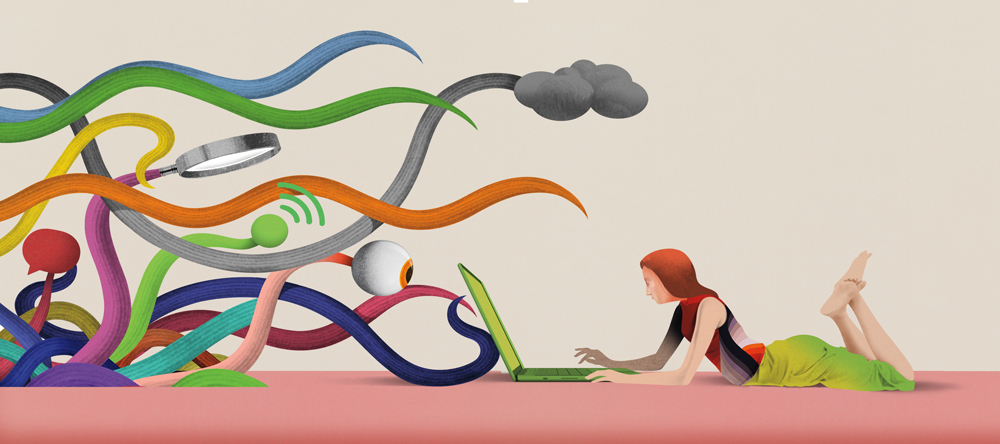
Credit: Illustration by Brett Ryder
“The calculations showed how much energy that swing arm could generate, and it was mind-blowing,” Lindauer recalls. “The machine self- destructed when we pushed it past its limits. Nobody was hurt, but it was a dramatic, unforgettable lesson in what happens when theory meets real-world engineering.”
Case was so successful in the MESA program that she began earning job offers straight out of high school. Rather than taking one of these positions, she followed the advice of a family friend and professor who encouraged her to attend a liberal arts college to develop her critical thinking skills.
Anthropology Meets Technology
At Lewis & Clark College, Case majored in sociology and anthropology. “I struggled with understanding people and wanted to learn how to make better things for them,” she says.
During her first year, a cyborg anthropology class with Professor of Anthropology Deborah Heath (now retired) refined her focus. Heath, a cultural anthropologist at the forefront of anthropology, science, and technology studies, says: “Human beings have always been intrinsically intertwined with their tools—whether contemporary or ancient. We use our tools as devices to extend our capacities; they shape us, and we shape them.”
Heath’s class directly inspired Case’s senior thesis. In 2007, just after the iPhone debuted, Case analyzed its effect on users, years before digital dependence became a mainstream concern. She began receiving speaking invitations, attending conferences, and crafting pitch ideas.
Case’s thought leadership soon earned her fellowships at MIT’s Center for Civic Media and Harvard’s Berkman Klein Center for Internet & Society, cementing her role as a bridge between technology, culture, and human-centered design. She was named a National Geographic Emerging Explorer; received the Claude Shannon Innovation Award from Bell Labs; and cofounded and served as CEO of Geoloqi, a location-based software company acquired by Esri.
Immersed in Portland’s then-underground tech scene, she began developing her ideas on calm technology—arguing that “while tech promises to give us more human time, it often becomes the main event instead.”
It took me a long time to grasp the amazingness of the human brain, and Amber showed me how wonderful humans can be.”
Kevin Lindauer
The Case for Calm Tech
Case developed the Principles of Calm Technology (see next page) with the belief that tech should take the least amount of attention, communicate only when necessary, and recede into the background, allowing people to live their lives more fully. “Alerts and notifications are overwhelming us. Calm tech is about giving us back our attention,” she says.
Heath frames Case’s work as an evolution of cyborg anthropology’s lineage: “The notion of calm tech is an intelligent response to our fears about technologies dehumanizing our experience. The fundamental response needs to be that the technologies don’t control the outcome—it’s the way humans use them.”
Case points to the Time Timer, created in the late 1980s, as an example of calm design. It’s a flat clock with a colorful disc that shows how much time remains in an hour. Powered by a single AA battery and turned by hand, it features a simple beep alarm that can be switched on or off. From across the room, the remaining time is visible at a glance, requiring no processing of numbers.
“When we spend too much time on screens we experience data overload,” Heath says. “We have, or ought to have, a role in governing our engagement with data, so that we decide where it fits in our lives instead of the other way around.”
While tech promises to give us more human time, it often becomes the main event instead.”
Amber Case
In 2016, Case began creating certification checklists to help companies design technology that enhances rather than interrupts the human experience. Named one of Inc. magazine’s 30 Under 30 and Fast Company’s Most Influential Women in Technology, Case has authored four books, including Calm Technology: Principles and Patterns for Non-intrusive Design (O’Reilly Media) and A Kids Book About Technology (DK Children), and presented talks around the world.
“Listening to Amber’s talks about calm tech was really inspiring,” says Silje Gabrielsen, cofounder and CEO of the children’s media-player start-up HiRO. “It was so refreshing that somebody has a language for this.”
From Principles to Practice
Case formalized her work in May 2024 by launching the Calm Tech Institute, which offers both certification and precertification programs to help companies ensure their products meet Calm Tech’s standards as they go to market. Many companies overlook potential issues—such as a bright LED that flashes all night—because prototypes are not tested in real-world conditions. Precertification identifies these problems early. Case envisions these standards functioning much like a LEED certification does for sustainable buildings: a widely recognized benchmark that signals to the public that a product has been designed with care for human well-being.
Principles of Calm Technology
According to Amber Case, technology should…
Require the smallest possible amount of attention
Inform and create calm
Make use of the periphery (i.e., move easily from our peripheral attention to the center and back again)
Amplify the best of technology and the best of humanity
Communicate but not necessarily by speaking
Work even when it fails (by defaulting to a usable state and not breaking down completely)
Reflect the minimum needed to solve the problem
Respect social norms
The Calm Tech Institute has advised on widely recognized consumer products, including the reMarkable digital notebook, known for its paperlike writing experience. Case’s Principles of Calm Design shaped its intuitive feel and minimalist interface, making it a favorite among writers, artists, and technologists.
Gabrielsen recalls Case’s feedback during their product launch for HiRO, a simple device that allows children to simply tap a card to play stories and songs as an alternative to screens. Users did not intuitively realize they could turn off the device by holding down a button, so the battery drained quickly, prompting a voice to alert the user. This could be a problem if it were to speak in the middle of the night and wake a sleeping child.
HiRO has since added a sleep mode to prevent the problem, and Gabrielsen credits Case with sharpening their employees’ thinking. “Most designers I know are really good at user interfaces on screens, but when you move into the physical space, it becomes challenging. Amber brings references from hardware, speakers, and lights—I’ve never met anyone with that much knowledge across different areas.”
Robin Moreau, partner and business designer at the Calm Tech Institute, adds that their work is broader than adapting screens. “It means redesigning technology broadly—materials, design, the built environment—so it quietly improves life.”
Invisible factors matter, too. In Norway, effective air circulation keeps CO2 levels low, supporting alertness and creativity; in many places, high CO2 indoors impairs decision-making and increases fatigue. Calm Tech Principles can address such issues. Case certified Airthings, a Norwegian company making elegant displays that show CO2 levels, enabling users to adjust their environments for better focus and health. “Small choices like these shape quality of life,” Case says.
Her influence is now global. Calm Tech Principles have been adopted by Microsoft, Samsung, Google, Virgin Global, and Airbnb, among others. “We’ve been shocked by how many companies—large and small—are reaching out,” Moreau says. “And not just tech companies. Calm tech touches all kinds of areas: mindfulness, wellness, education, even hospitality. They’re all asking how to design environments that reduce stress. Our environment is technology, as Amber would say, so anyone can be part of it.”
The Human-Centered Future
Case sees herself as a one-person quality assurance department, constantly spotting opportunities to improve products and experiences.
That sensitivity underscores a paradox: despite what can seem like almost superhuman abilities, Case is the first to emphasize her own humanity. Others see it, too. Gabrielsen describes her as deeply approachable: “When I met Amber, it felt like I’d known her forever. She really understands what it’s like to build things—how hard it is and how long it takes.”
Case often returns to her earliest lessons in design—those childhood nights spent dozing off to the hum of her father’s handmade inventions or jolted awake by a too-sensitive lamp. The contrast between elegant design and flawed execution still shapes her philosophy today.
“Beauty is memorable, soothing, and encourages people to care for and engage with their surroundings,” Case says. “It brings life and surprise into everyday moments, making spaces feel alive instead of like sterile storage containers for our souls. Beauty in design makes technology feel human and joyful.”
That human-centered vision, Case and her colleagues say, is more urgent than ever. The rise of AI, constant notifications, and workplace burnout have made people increasingly aware of the hidden costs of technology. “We keep making screens sharper and faster, but people are more stressed than ever,” Moreau says. “Calm Tech offers another path.”
Credit: Illustration by Brett Ryder
L&C Magazine is located in McAfee on the Undergraduate Campus.
The L&C Magazine staff welcomes letters and emails from readers about topics covered in the magazine. Correspondence must include your name and location and may be edited.
L&C Magazine Lewis & Clark 615 S. Palatine Hill Road PortlandOR97219
Capping an intensive collaboration with Portland advertising legends Wieden+Kennedy, Lewis & Clark has unveiled the design of its new River Otter Mascot.